


AUSTRALIA CHESS
NOVEDADES
Entérate de todo

AUSTRALIA CHESS

BOARD
AUSTRALIA CHESS
Is a variant with many features like is to the chess.
Created by AustraliaChess.
https://www.instagram.com/australiachess/
https://twitter.com/AustraliaChess
https://www.facebook.com/AustraliaChess/
contact: australiachess@yahoo.com
PIECES
WHITE
Black
DESCRIPTION
A king
A lady, also popularly known as Queen 3
Two bishops
Two Kangaroo
Two towers, also known as roques
Eight pawns
The King can move in any direction (vertical, horizontal and diagonals) advancing or going back a single square (except in castling, in which he moves 2 squares - short castling - or 3 squares - long castling -).
The Queen or Queen can also move in any direction (vertical, horizontal and diagonals) advancing or retreating on the board the number of squares that you want, until it hits another piece or the edge of the board.
The Bishop can only move diagonally, as many squares as desired, but always diagonally and in the color that belongs to him.
The Rook can only be moved in the vertical and horizontal directions, not diagonally, the desired squares.
The Kangaroo, can move in any direction (vertical, horizontal and diagonal) forward or backward on the board the number maximum of two boxes is desired including to jump over the other part , but only by choosing a direction of the three mentioned , until it hits another piece or the edge of the board .
The Pawn can advance one or two squares in a vertical direction in its first move, after advancing for the first time it can only advance one square, unlike the rest of the pieces it cannot go backwards and cannot capture the opposing pieces that are in the same direction in which he moves, he will only be able to do so if they are one square diagonally from him (except in passing pawn taking). A pawn has the ability to transform into the piece that its player wishes (usually a queen) if it is able to reach the last row of the board opposite that of its side, so a pawn can acquire enormous tactical power in certain positions where he has no opposition to "crown" (passed pawn).
R EGLAS
When the game starts, one player controls 16 white pieces and another player controls 16 black pieces. The color assigned to each player is usually drawn, although in the case of tournaments it depends on the pairing of the players. The board is placed in such a way that both players have a white square in the respective right corner square. The parts are located as shown in the diagram below . The rooks, ca nguro and bishops closest to the king are usually called king (example: king's rook) and those furthest away, closest to the queen are called queen (example: queen bishop). Likewise, the side where both kings meet is usually called the kingside and the other queenside.
Players move in turns. On each turn, a player can only move one piece (with the sole exception of a special move called castling, in which the king moves two squares to the right or left and the rook is placed on its opposite side). The player who plays with the white pieces is always the one who moves first.
The pieces can not jump, in its movement, one above the other (except for the Kangaroo and the castling).
A piece can not occupy a square occupied by another piece of the same color, but one occupied by another of the opposite, removing it from the board. This action is known as "take" or "capture", and is voluntary, at the player's discretion.
The squares to which a piece can move are said to be controlled by it. If a piece is within the squares controlled by a piece of the opposite color, it is attacked by that one.
The king is the only piece that cannot move or go through squares controlled by opposing pieces.
A move that attacks the king is known as check; it is mandatory for the player whose king is attacked to get out of check. If there is no defense against a check, the king is checkmate. That is the objective and whoever inflicts it on the rival king wins.
A chess game also ends when a player decides to surrender or quit, or if he exceeds the allotted time; in both cases the opponent wins the game. Also the game ends when victory is not possible for either player, or if both agree on this result, known as a draw or draw. Likewise, the game ends in a draw if the same position on the board is repeated three times (by repetition of moves), when none of the players has enough pieces to checkmate, or if the player who has the turn cannot make any move regulatory, situation known as drowning.
In tournaments, and in order to compute the results, the winner of a game is awarded one point, half a point to each player who has drawn, and zero points to the loser of a game. In some tournaments 3 points are applied to the winner; one point to each player if there are a draw and zero points to the loser of a game.
BOARD
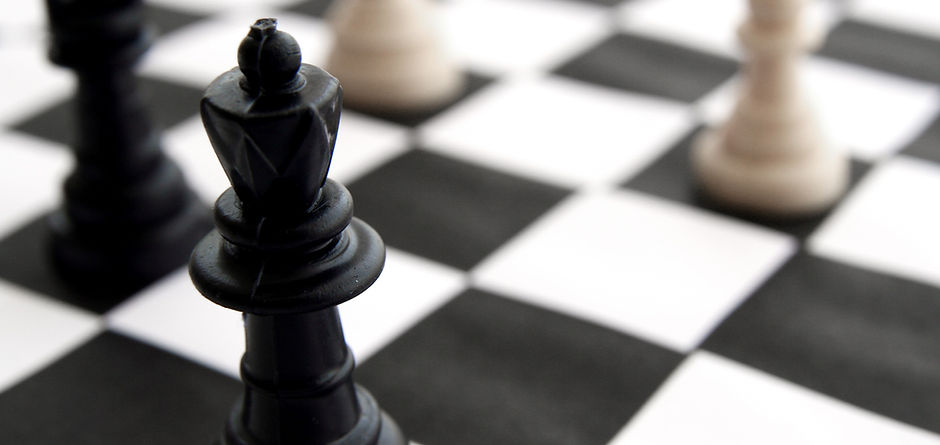
The chess board is a square subdivided into 64 equal squares or squares (8 × 8), also square, alternately light and dark in color. Each player faces the opposing chess player, placing the board in such a way that each player has a white square in their right corner .
Bibliography:
Wikipedia. [Consulted 11 September 2020]; Available at: https://es.wikipedia.org/wiki/Ajedrez